Acceptance and Commitment Therapy (ACT) is an action-oriented approach built on empirically based principles that emphasizes contacting the present moment, increasing psychological flexibility, accepting thoughts and feelings without judgment, and engaging in committed actions towards living a life guided by your values. It utilizes a range of techniques that incorporate mindfulness based approaches and behavior change strategies. It provokes the question:
Are you willing to accept what and how you feel and your situation and commit to persisting in an action that is most important to you?
Acceptance and Commitment Therapy has been studied to be helpful in addressing the following concerns:
- Anxiety
- Depression
- Obsessive-Compulsive Disorder
- Stress
- PTSD
- Substance use
- Burnout
- Chronic Pain
- and more…
How does Acceptance and Commitment Therapy Work?
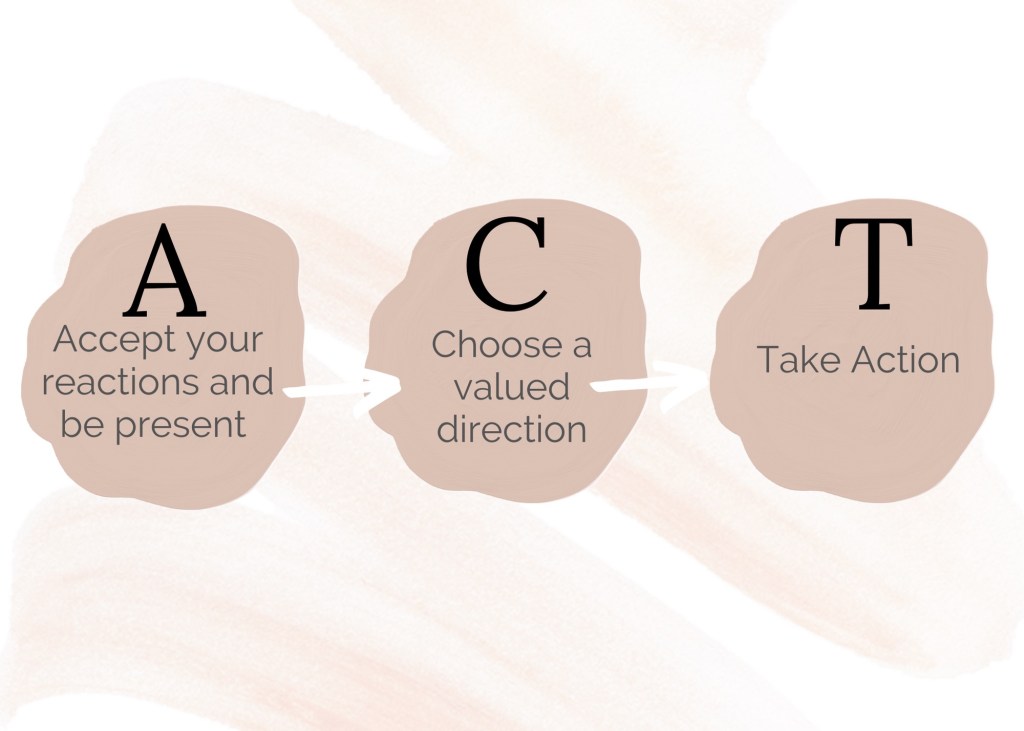
Many of us have been socialized to evaluate our thoughts/feelings as negative experiences. However, think about how this makes us feel? If we are feeling anxious and then start to feel anxious about the fact we are feeling anxious and then get sad and angry at ourselves for not being able to control or stop these feelings – we can see how this really produces more suffering. So the goal of ACT is not to reduce certain symptoms or even “get rid” of feeling anxious or depressed- it is to have and experience the way you feel and accept it.
Try reframing “ I’m having a negative emotion” to “these are natural emotions part of the human experience”
We oftentimes find ourselves fighting our feelings or avoiding situations that might bring about certain feelings. We may use food, substances, toxic relationships, isolation, avoidance, anger, and other maladaptive coping strategies to try and not feel the extreme discomfort of our life experiences. And we end up trying to move away from our pain, only to create more suffering inside of us.
Rather than engage in this struggle, we can learn to confront our workable reality and observe oneself as experiencing the feeling and practice acceptance for it – which is one of the key parts of ACT therapy (Read more about this). With acceptance we are actively contacting our psychological experiences (thoughts/feelings) directly, fully, and without needless defense. You accept the things that you can’t change and recognize courage to change the things that are within your control, and ACT therapy hopes to impart the wisdom to be able to know the difference. ACT therapy aims to help you handle uncomfortable/painful thoughts and feelings more effectively and create a rich, full, and meaningful life as defined by YOU!
The Six Core Principles of ACT
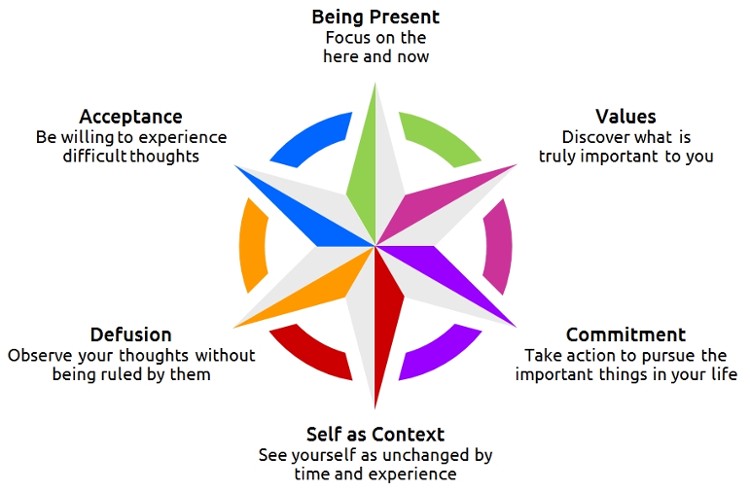
- Contacting The Present Moment means being psychologically present: mindfully connecting with whatever is happening right here, right now. It involves having an awareness all your five senses, practicing various forms of meditation, learning to ground ourselves in our bodies, and practicing self-compassion, just to name a few.
- Defusion means learning to step back or detach from unhelpful or intrusive thoughts. Instead of getting “hooked” your thoughts or struggling to get rid of them, you learn how to let them come and go. You will learn how to take a step back, put a pause in place, and notice your thinking, so you can respond rather than react to challenging situations. You are not your thoughts.
- Acceptance means opening up, making room, and allowing for painful thoughts, feelings and memories. You learn how to drop the struggle with them, and let them be there without getting overwhelmed by them. Acceptance is often the first step to long-term healing.
- Self as Context (The Observing Self”) is the part of you that is responsible for awareness and attention. It is our “observing mind’. There are two sides to mental processes: The first is the “thinking self”, or the part of us that is responsible for all our thoughts, beliefs, memories, judgments, fantasies etc. The second is the “observing self”, which is that part of us that is aware of our thoughts and our feelings from a less attached or judgmental perspective. This “observing mind” is a critical component in mindfulness. The more you practice the mindfulness skills, the more you’ll notice this part of your mind and will be able to access it when you need it.
- Values are the things that you find meaningful in your life. They are the things your stand for and what is most important to you. What kind of person would you like to be in the world, and what would you like to be remembered for by the people you love? Those are your values.
- Committed Action is the “now what” part of ACT. It means taking action that is guided by your values and doing what matters, even when it’s difficult or uncomfortable.
When you begin to practice these principles altogether, you develop ‘psychological’ flexibility. This is the capacity to contact the present moment, with awareness and openness, and take action that is guided by your values.
Psychological flexibility, is the ability to be present, open up, and do what matters.
The greater your ability to be present, open up and do what matters, the greater your quality of life – the greater your sense of vitality, wellbeing and fulfillment.
Resources
What is ACT Therapy – https://www.actmindfully.com.au/about-act/
Acceptance and Commitment Therapy Official Website – https://contextualscience.org/act
 Michelle Zaragoza, LCSW
Leave a comment